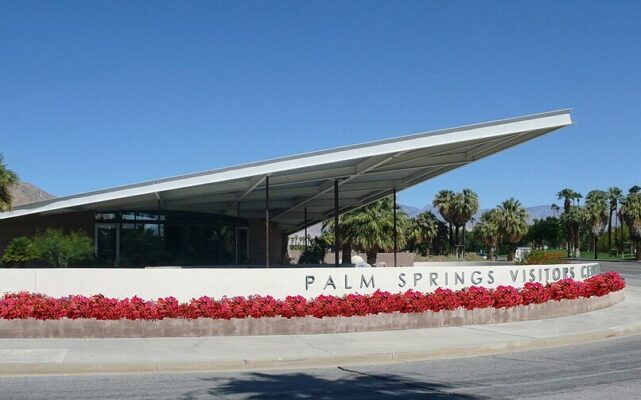

Palm Springs doesn’t just sit in the desert — it was designed for it. In the postwar boom of the 1940s through the 1960s, a remarkable concentration of architects descended on the Coachella Valley and built something that still stops people cold. Clean lines, glass walls, flat roofs cantilevered over swimming pools, homes that treated the desert landscape as a feature rather than a problem to solve.
The good news for cyclists is that most of it is accessible, relatively flat, and concentrated enough to take in on two wheels. This route covers the downtown core — a 7.86-mile loop through the highest density of midcentury landmarks in the city, starting and finishing at an architecture museum. It’s a legitimate ride with a legitimate purpose, and it doesn’t require a car shuttle or special access. Just show up and pedal.
The Downtown Architecture Loop
7.86 miles — Mostly flat with one short climb — Estimated time: 45–75 minutes — Difficulty: Easy to Moderate
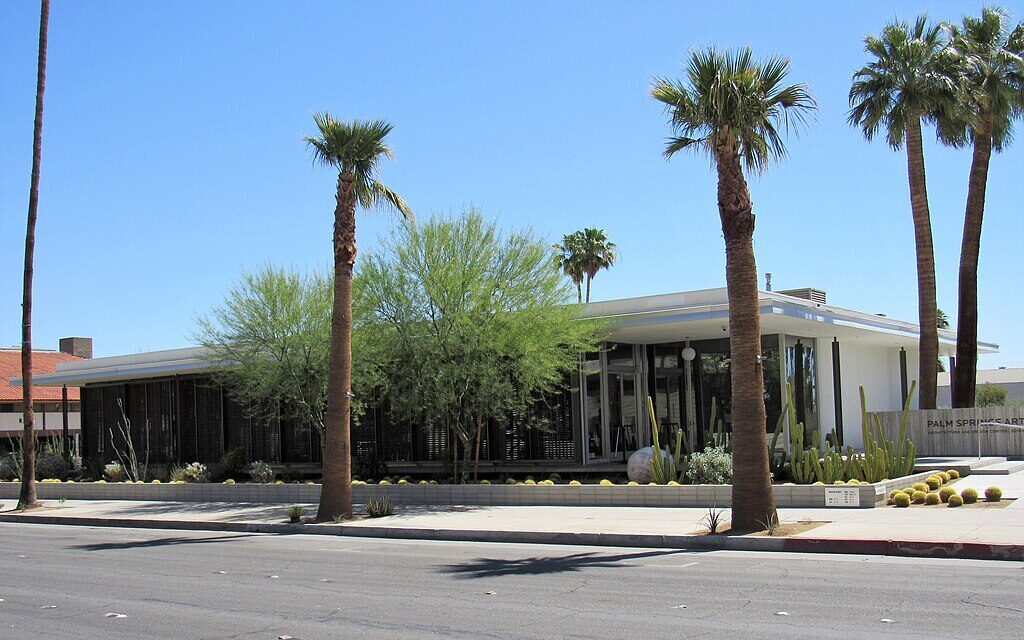
Start: Palm Springs Art Museum Architecture & Design Center
300 S Palm Canyon Dr — E. Stewart Williams, 1961
The building is your first stop before you clip in. This former Santa Fe Savings & Loan was designed by E. Stewart Williams in 1961 — the drive-through window and original vault are still intact inside. The Art Museum acquired the property in 2014 and converted it into a dedicated design center. It’s open Thursday through Sunday, and a short visit before the ride gives you a useful frame of reference for everything you’re about to see. When you’re done, you’ll circle back here — it’s a satisfying loop to start and end at an architecture museum on a ride about architecture.
Stop 1: Del Marcos Hotel
225 W Baristo Rd — William Cody, 1947
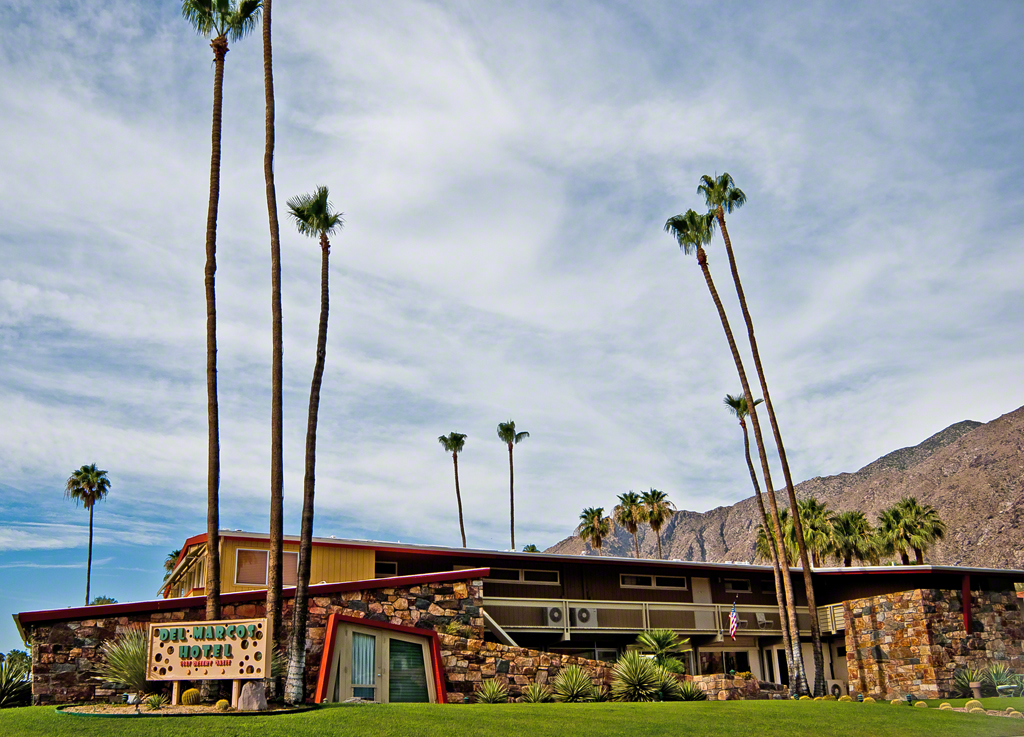
From the Design Center, the Del Marcos is steps away — practically in the same parking lot. This was William Cody’s first solo commission, completed in 1947 when he was just establishing his Palm Springs practice. The bold angled roof, stone facade, glass-enclosed lobby, and open breezeway won the American Institute of Architects Design Award, and it’s still operating as a hotel today. It’s worth a slow pass rather than a sprint — the geometry of the angles hits differently when you’re eye level on a bike than from a car window.
Stop 2: Palm Springs Historical Society
221 S Palm Canyon Dr
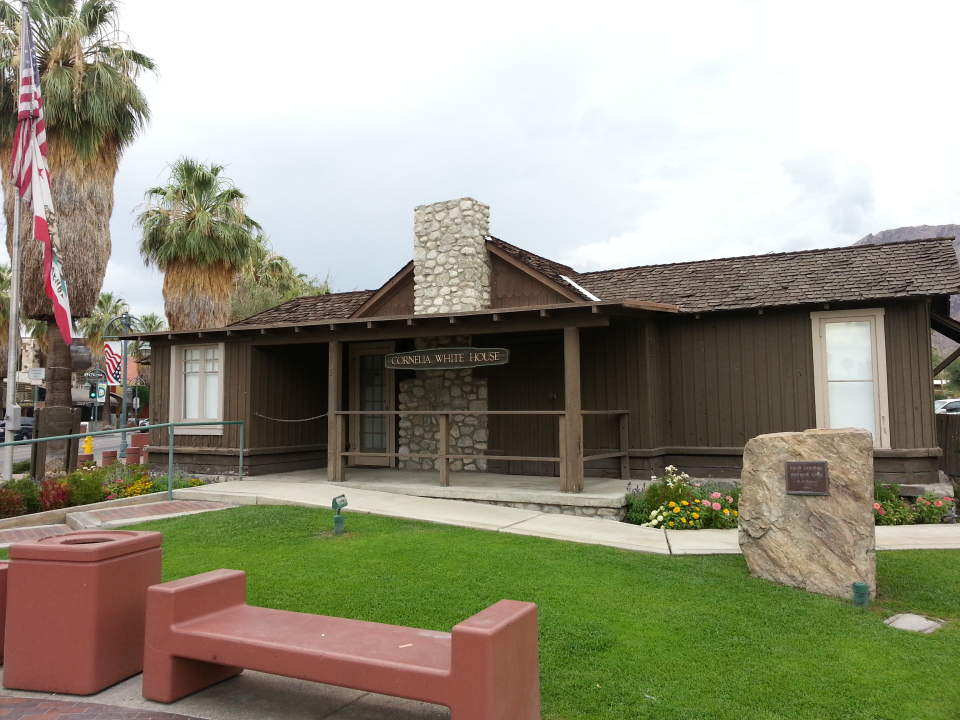
A quick pass-by heading back north on Palm Canyon. The Historical Society runs architectural walking tours out of here that are genuinely worthwhile if you have the time on another visit. For our purposes, it’s a reference point — and a reminder that the density of significant architecture on this short stretch of Palm Canyon is not accidental. It was the main commercial corridor of a city that was being built by architects with something to prove.
Stop 3: Fire Station No. 1
277 N Indian Canyon Dr — Albert Frey & Robson Chambers, 1957
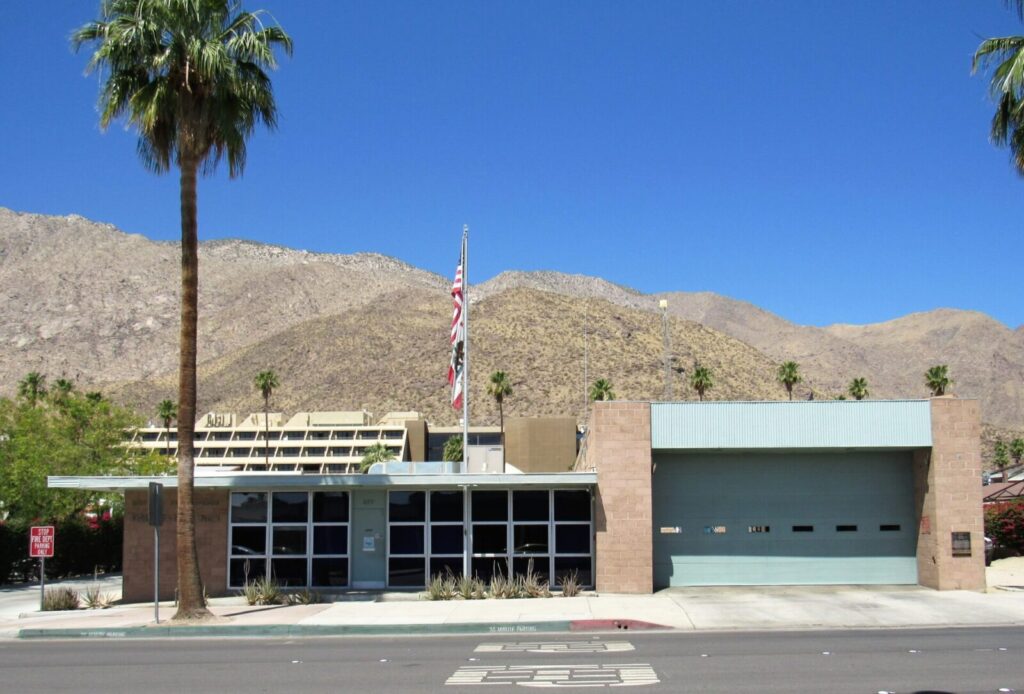
Head north on Palm Canyon, then cut east to Indian Canyon Drive. Fire Station No. 1 is a perfect Frey building in miniature — colored concrete block, corrugated aluminum, the industrial materials he loved to work with repurposed into something that reads as both functional and composed. It was built in 1957, and it’s still an active fire station. The architectural significance is easy to miss at speed, which is exactly why this ride is better on a bike than in a car.
Stop 4: Frey House II
686 Palisades Dr — Albert Frey, 1964
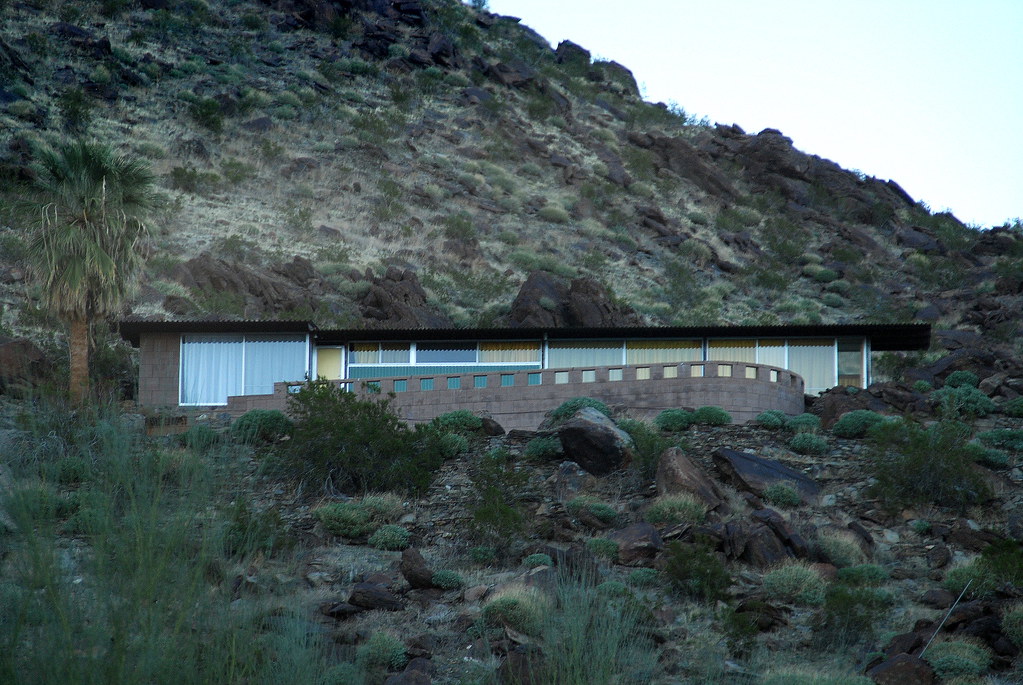
This one requires a short climb — and it’s worth every foot of it. Albert Frey built his own home into the Palisades hillside in 1964, incorporating a massive granite boulder directly into the living space. The boulder comes through the floor, serves as a room divider, and continues through the roof. It’s one of the purest expressions of desert modernism anywhere: the landscape doesn’t stop at the wall. It continues right through the middle of the house.
Frey House II is now operated as a museum by the Art Museum and is one of the few midcentury homes in Palm Springs you can actually go inside. The views down into the valley from up here are the kind that reward the climb twice over. The descent back down Palisades Drive is quick — respect it.
Stop 5: Frank Sinatra Twin Palms Estate
1148 E Alejo Rd — E. Stewart Williams, 1947
From Frey House, drop down into the Movie Colony. The Twin Palms Estate was Sinatra’s first Palm Springs home, built by E. Stewart Williams in 1947. Sinatra came in wanting a Georgian mansion — columns, brick facade, the whole statement — and Williams talked him out of it. The result is one of the most celebrated houses Williams ever designed: horizontal planes, desert materials, a piano-shaped pool that became the postcard image of Palm Springs glamour. Williams later said they would have been ruined if they’d built Georgian in the desert. He was right.
The estate is privately owned and operates as an event rental venue. You’re viewing from the street, which is completely sufficient — the grounds are immaculate, and the exterior read is everything.
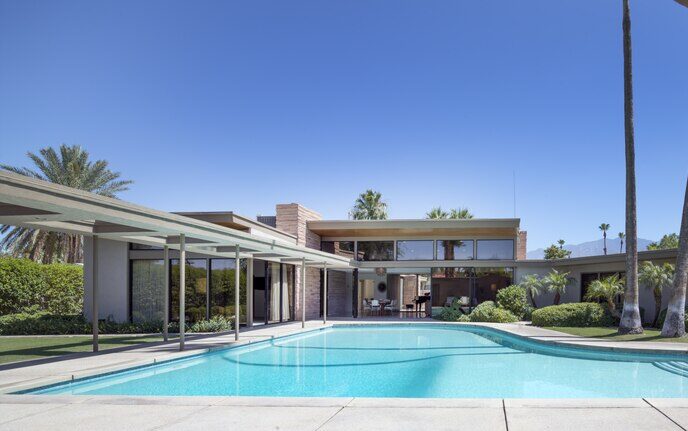
Stop 6: Elvis Honeymoon Hideaway
1350 Ladera Cir — William Krisel / Alexander Construction, c. 1960
Continue north into the Las Palmas neighborhood. The House of Tomorrow — better known as the Elvis Honeymoon Hideaway — was an Alexander Construction project designed by William Krisel, the architect responsible for thousands of midcentury tract homes throughout the Coachella Valley. This wasn’t a tract house. Stepping-stone entry over a decorative stream, Moroccan-inspired front doors, a futuristic roofline that earned it the nickname before Elvis ever pulled into the driveway. Elvis and Priscilla spent their honeymoon here in 1967. It’s a private residence today.
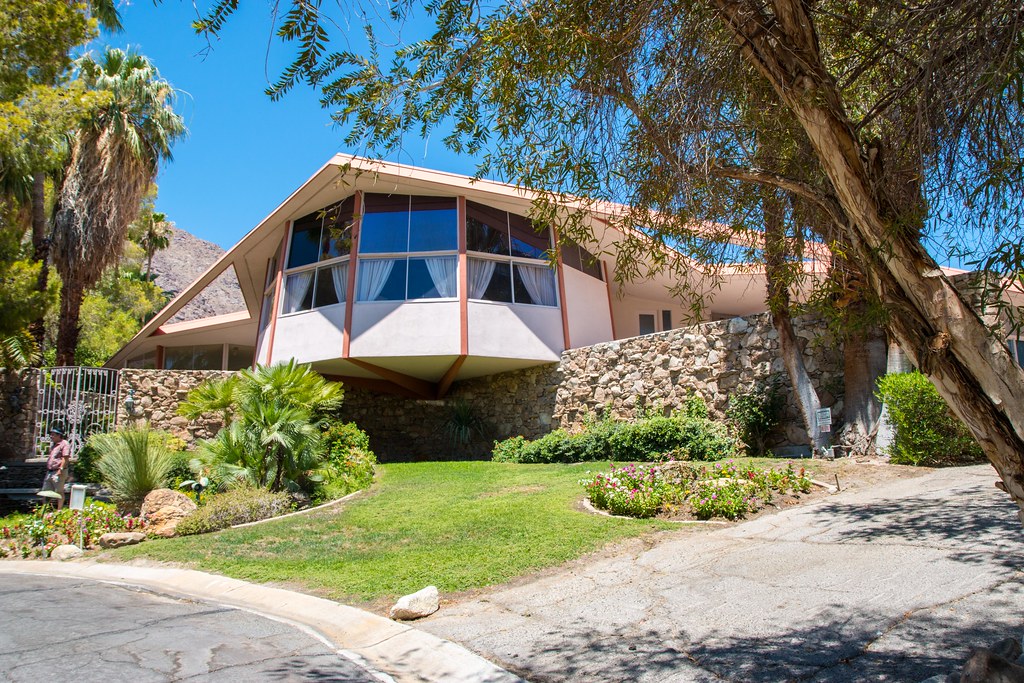
Stop 7: Dinah Shore Estate
432 Hermosa Pl — Donald Wexler, 1964
Still in Vista Las Palmas, the Dinah Shore Estate is a Donald Wexler design from 1964. Wexler was one of the most prolific architects working in Palm Springs during this period — he designed everything from the Steel Development Homes in Racquet Club Estates to the main terminal at Palm Springs International Airport. The Shore residence is among his most refined residential work. It’s currently owned by Leonardo DiCaprio. Private residence, exterior view from the street.
Stop 8: Kaufmann Desert House
470 W Vista Chino — Richard Neutra, 1946
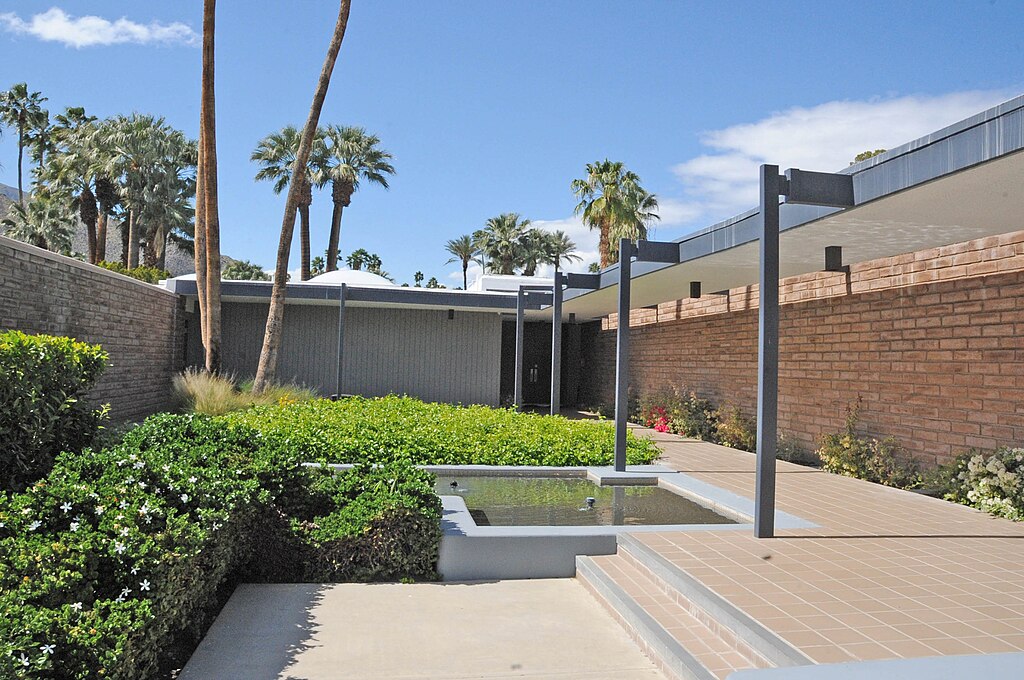
The Kaufmann Desert House is the most significant building on the route, and possibly in the city. Richard Neutra designed it in 1946 for department store heir Edgar Kaufmann Sr. — the same client who commissioned Fallingwater from Frank Lloyd Wright. The pinwheel floor plan opens every corner of the house toward a different desert view, and Julius Shulman’s photographs of it became defining images of California modernism worldwide.
It’s a private residence. You’re viewing from the street on Vista Chino. The setting against the San Jacinto mountains makes the exterior view worth the stop on its own.
From Kaufmann, head south on Palm Canyon back to the Architecture & Design Center to close the loop.
Honorable Mentions
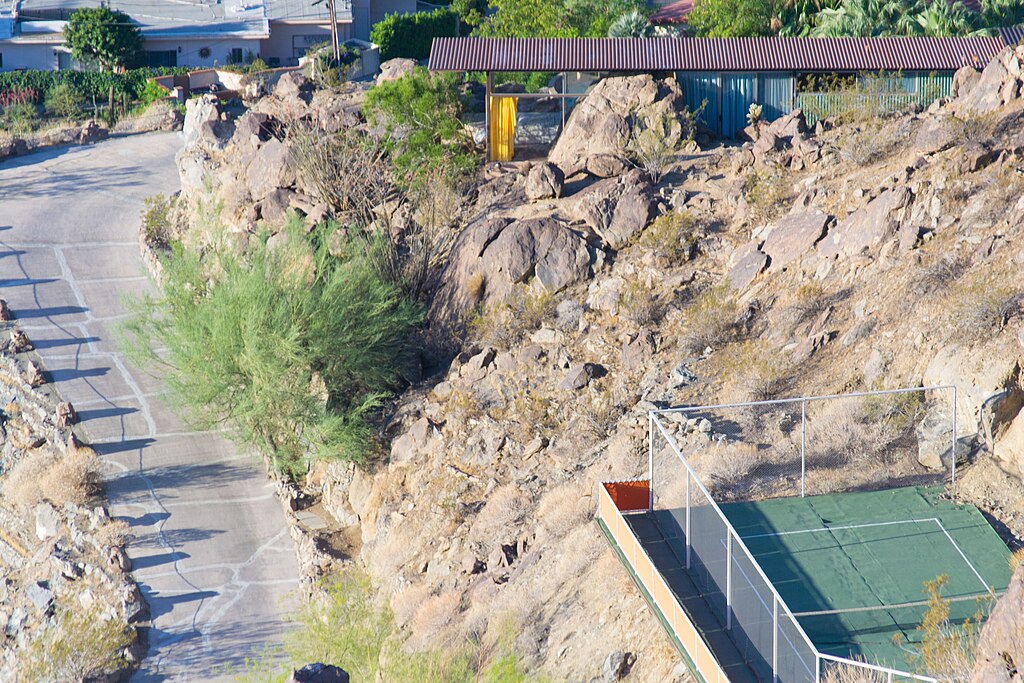
Two buildings didn’t make the main route for practical reasons — geography and gradient — but they’re significant enough to mention. If you have the legs and the time, both are worth the detour.
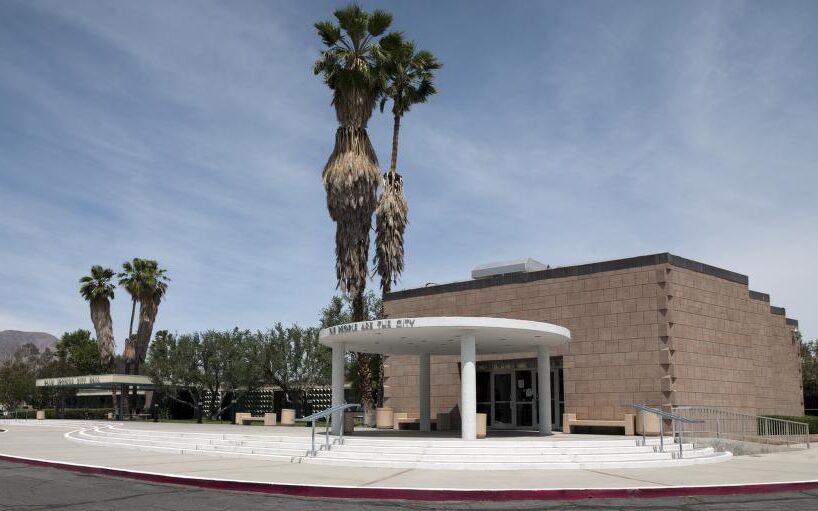
Palm Springs City Hall
3200 E Tahquitz Canyon Way — Albert Frey, 1963
Frey’s boomerang roofline is one of the most photographed silhouettes in Palm Springs. It sits well east of the main route, which is why it didn’t make the loop — but if you want to add an out-and-back on Tahquitz Canyon, it’s a public building, and you can ride right up to it.
Elrod House
2175 Southridge Dr — John Lautner, 1968
John Lautner, 1968. Famous as the Bond villain lair in Diamonds Are Forever. Left off the route because the climb up Southridge Drive is sustained and steep — 10% grades. Worth knowing about. Worth earning.
Practical Notes
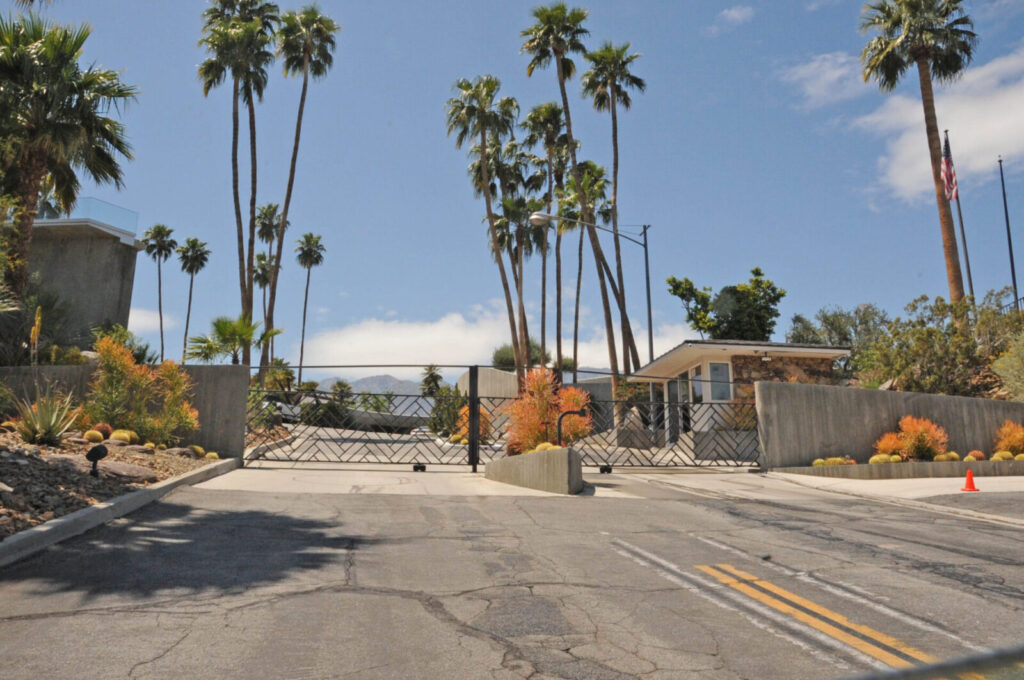
Most of the homes on this route are private residences. You’re viewing from public roads — that’s the arrangement, and it’s entirely sufficient. Stay on the street, don’t approach gates or pull into driveways. The neighborhoods are quiet and the residents are used to cyclists and architecture tourists. Be a good ambassador for both.
Modernism Week runs every February and draws architecture enthusiasts from across the country. If you’re timing a trip specifically for the architecture, the festival adds open houses, tours, and events that aren’t available the rest of the year. More at modernismweek.com.
Best time to ride: Early morning. Better light for the buildings, cooler temperatures, and less traffic on Palm Canyon Drive. The winter months — November through March — are ideal for the Coachella Valley generally. Summer mornings work but commit to being out and back before 9am.
Starting point parking: Street parking on Palm Canyon is metered but available. The Civic Center parking structure a block east is a reliable option for a longer visit.